Less coordination
Teams spend less time reconstructing context — who is coming, what is prepared, what changed — because the operational record is already there.
SOLUTIONS · THE CHOOSER
A clinic, studio, or multi-location team may work very differently. But behind every booking are people, schedules, resources, customers and changes that need to stay coordinated.
One platform, three operating worlds. The deep industry detail lives on each solution page — this is where you find yours.
01 — THE COMMON PROBLEM
Who is available? Which resource is free? What changed? Who needs to know? What happens next?
QUE brings that context together so the team doesn't have to reconstruct it every time.
A clinic's chain carries intake, provider and room. A studio's chain carries class, capacity and substitution. A multi-location chain carries local prices and central reporting. The steps are the same — QUE keeps them in one place.
02 — CHOOSE YOUR OPERATION
Three operating worlds, one product. Each solution page goes deep on the industry that matters to you — this is the doorway.
SOLUTION 01
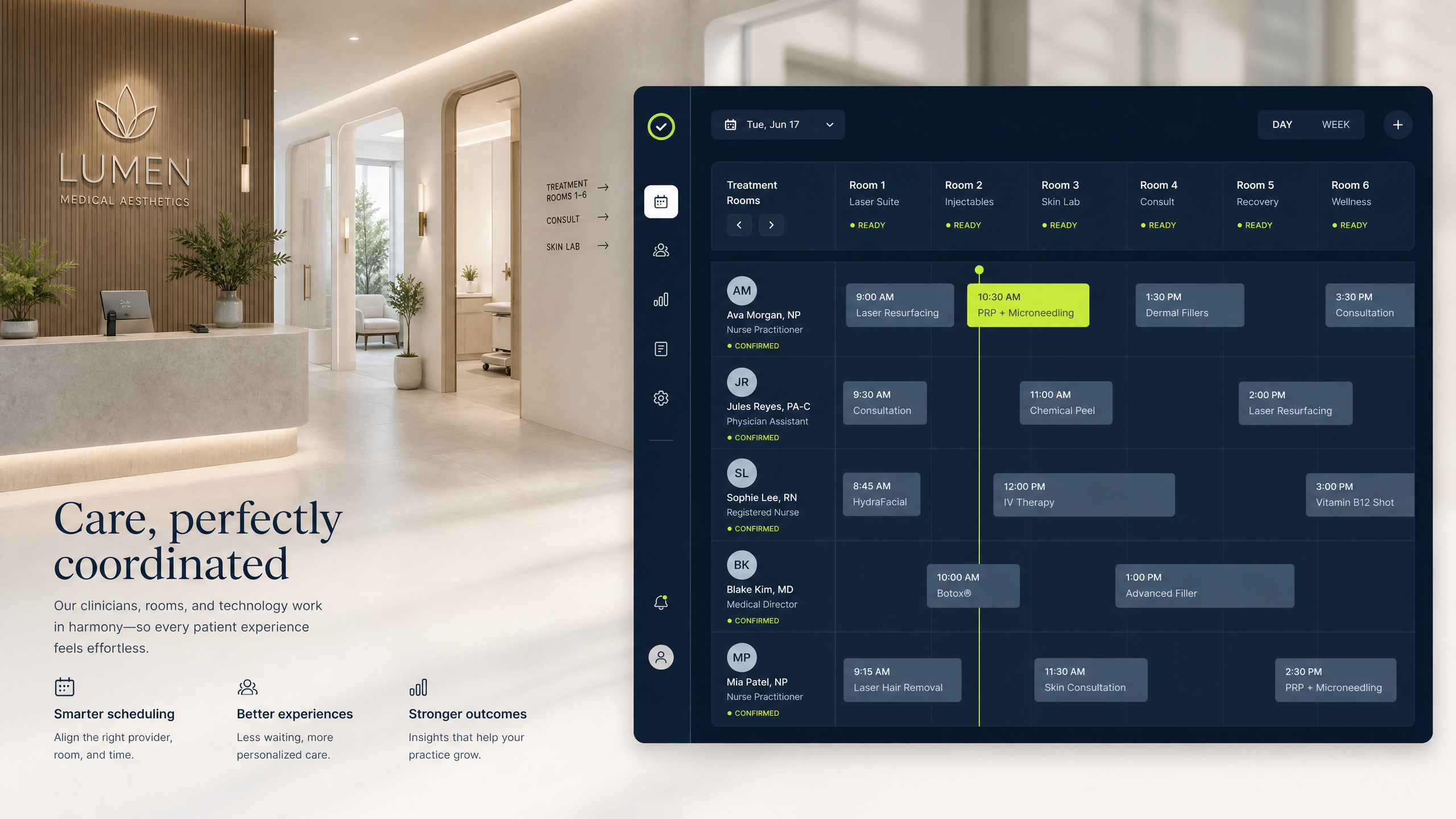
Keep practitioners, consult rooms, medical devices, and patient histories synchronized so front desk never scrambles during afternoon rushes.
SOLUTION 02
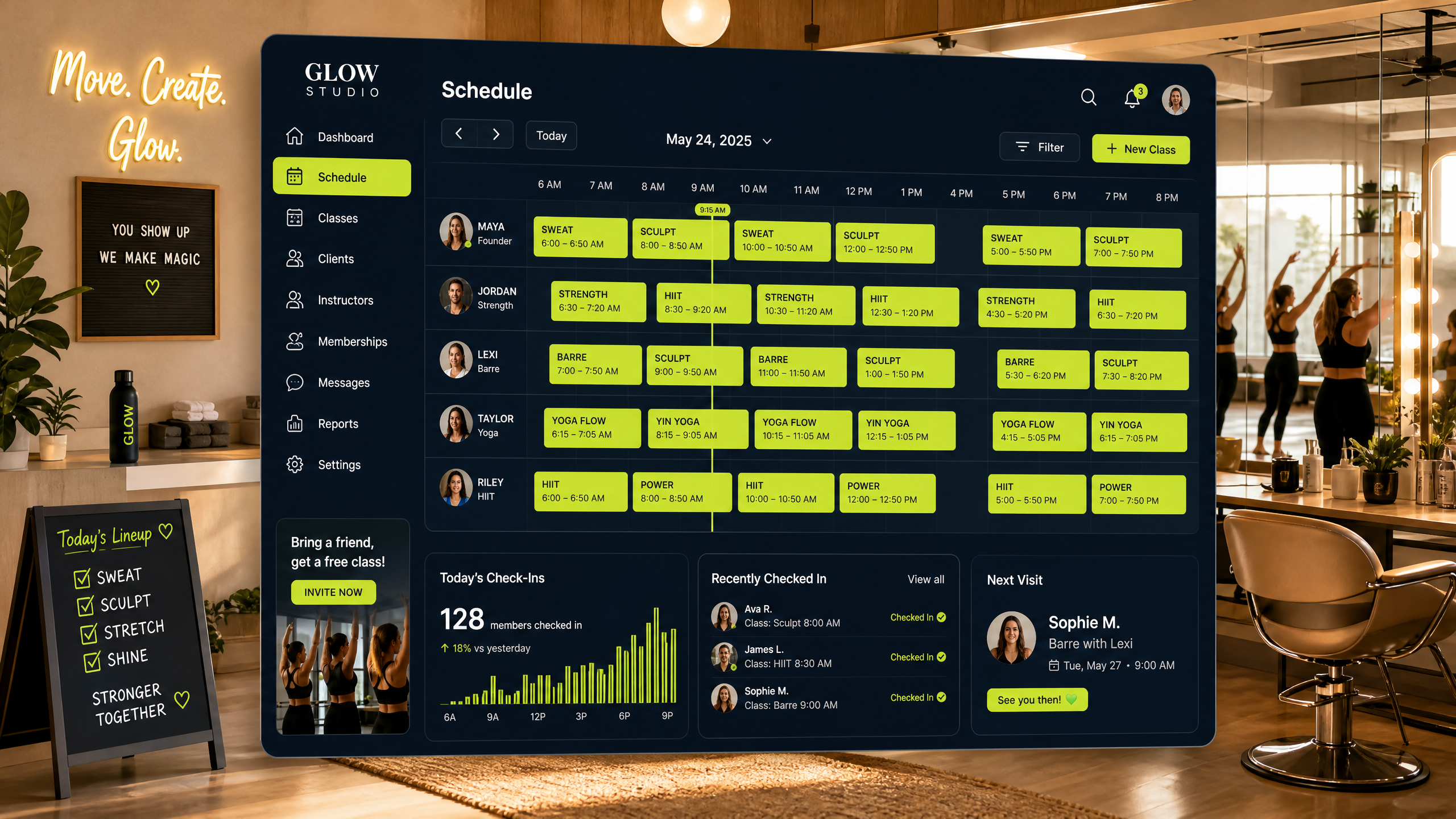
Eliminate no-shows with automated card holds, manage stylist commissions, and fill cancellations instantly with automated waitlist promotion.
SOLUTION 03
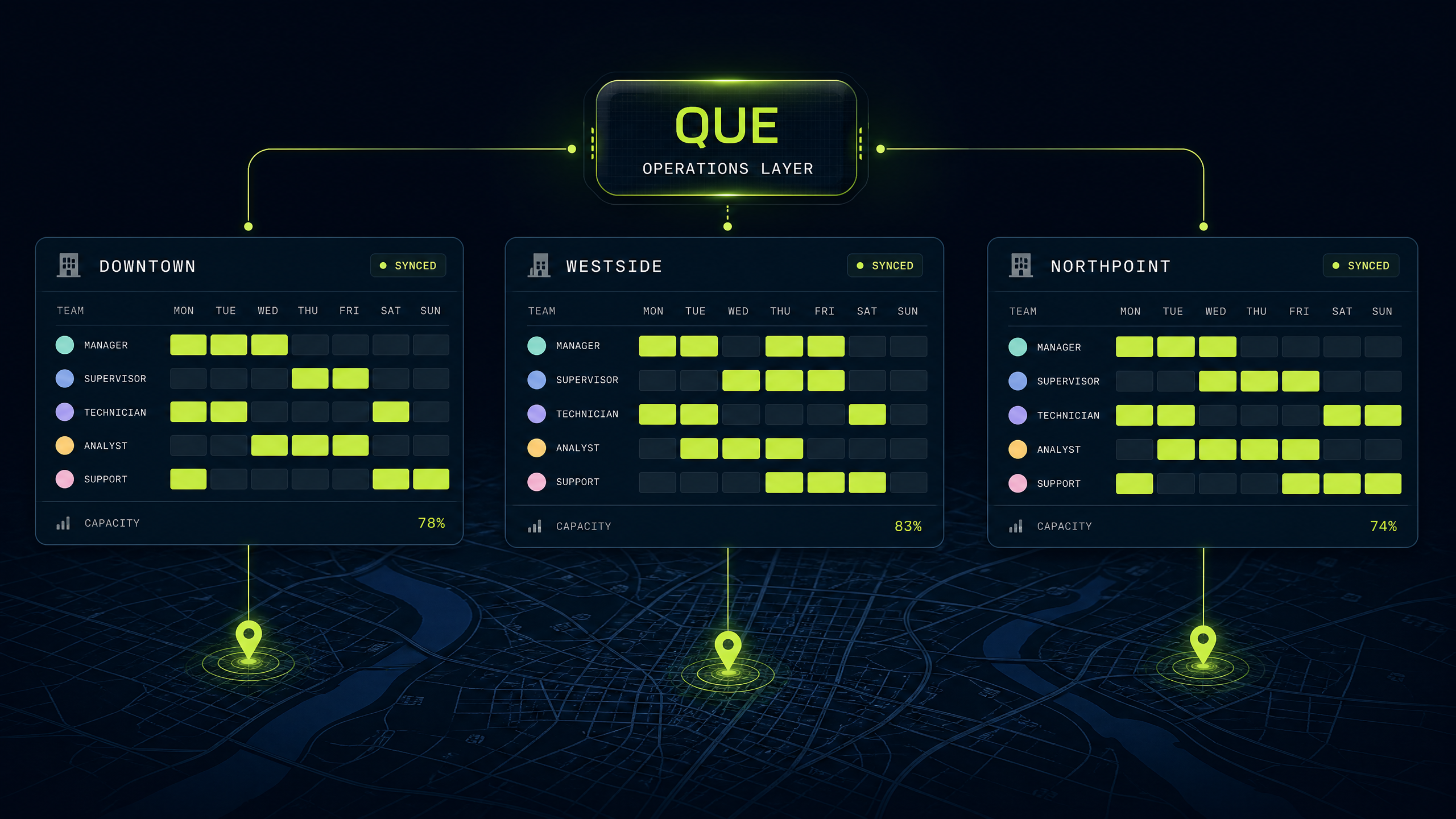
Centralize your master service catalog and pricing while giving local clinic managers shift control and custom opening hours.
03 — ONE FOUNDATION
Every solution runs on the same five platform capabilities. Industries differ in the rules; the layer underneath does not.
One platform layer — bookings, coordination, context, automation and visibility — shared by every industry it serves.
Bookings and honest availability.
Teams and resources in one place.
Customers and their context.
Reminders and recurring work.
Visibility and decision-making.
04 — SEE YOUR SCENARIO
Select your operating world. The same product concepts take on the shape of your business.
The terminology changes. The product underneath does not.
05 — A DAY IN THE OPERATION
Three operating days, told in the order they actually happen. Every scenario here is a real product flow.
Today's appointments arrive with completed intake, consent and preparation — the front desk sees what is ready and what is not, before the first patient walks in.
A provider is delayed and two appointments move. The rooms, equipment and buffers move with them, and the affected patients get new reminders automatically.
Follow-up reminders, after-care notes and review requests go out on schedule — and the day's bookings, payments and no-shows are already written down.
06 — THE TRANSFORMATION
Drag the handle to move between the two states of the operation.
BEFORE — FRAGMENTED
Calendar
Messages
Spreadsheet
Separate customer data
Manual coordination
WITH QUE — CONNECTED
Booking
Context
People
Resources
Communication
Operational state
07 — WHAT CHANGES
What operators actually get when the chain of work around the booking is connected.
Teams spend less time reconstructing context — who is coming, what is prepared, what changed — because the operational record is already there.
Operators see what needs attention today — not what was already discussed in three different tools. Exceptions surface instead of hiding.
Customers experience a coherent workflow end to end — the same brand, the same confirmations, the same follow-up — wherever the booking happens.
New teams, services or locations operate from shared foundations — the catalog, roles and workflows that already work — where supported.
08 — HONEST FIT
Trust starts with honesty about fit. Here is where QUE earns its place in your operation — and where it does not.
Your operation revolves around bookings
Multiple people or resources affect availability
Changes create manual follow-up
Your customer experience matters
You are growing beyond a simple calendar
You need more operational visibility
A simple calendar fully solves your workflow
Your operation has almost no coordination complexity
You don't need shared operational context
09 — ORIENTATION
A minimal comparison to orient you. Only verified capabilities — the depth of each column lives on its own page.
Every cell is real product capability. Location management is the multi-location system — shared catalog, overrides and roll-up reporting — which does not apply to a single-site clinic or studio.
10 — PRODUCT DEPTH
The same design system, the same operational records and the same workflow engine — presented in the shape of each industry. The solution pages are variations of one product.
The interface adapts to the industry; the system underneath is one.
11 — THE STRATEGY
Every service business lives the same reality: demand arrives, time is the scarce resource, people and resources make it happen, commitments are made, and follow-up decides whether the customer comes back.
QUE provides an operational layer around that reality — whatever industry the business belongs to. That is why one platform serves three very different worlds. Why QUE
12 — SUPPORTING PATHS
Supporting pages for context beyond the industry fit.
13 — PLATFORM CAPABILITIES
The same security, automation, analytics, and integration layer underneath every industry surface.
 Security & Isolation
 Automation
 Analytics
 Embed Widget
 Multi-Location
 Partners
THE NEXT STEP
Explore your workflow, see the product in context, and understand where QUE can take you. The solution page carries the deep detail — the conversation carries everything else.